
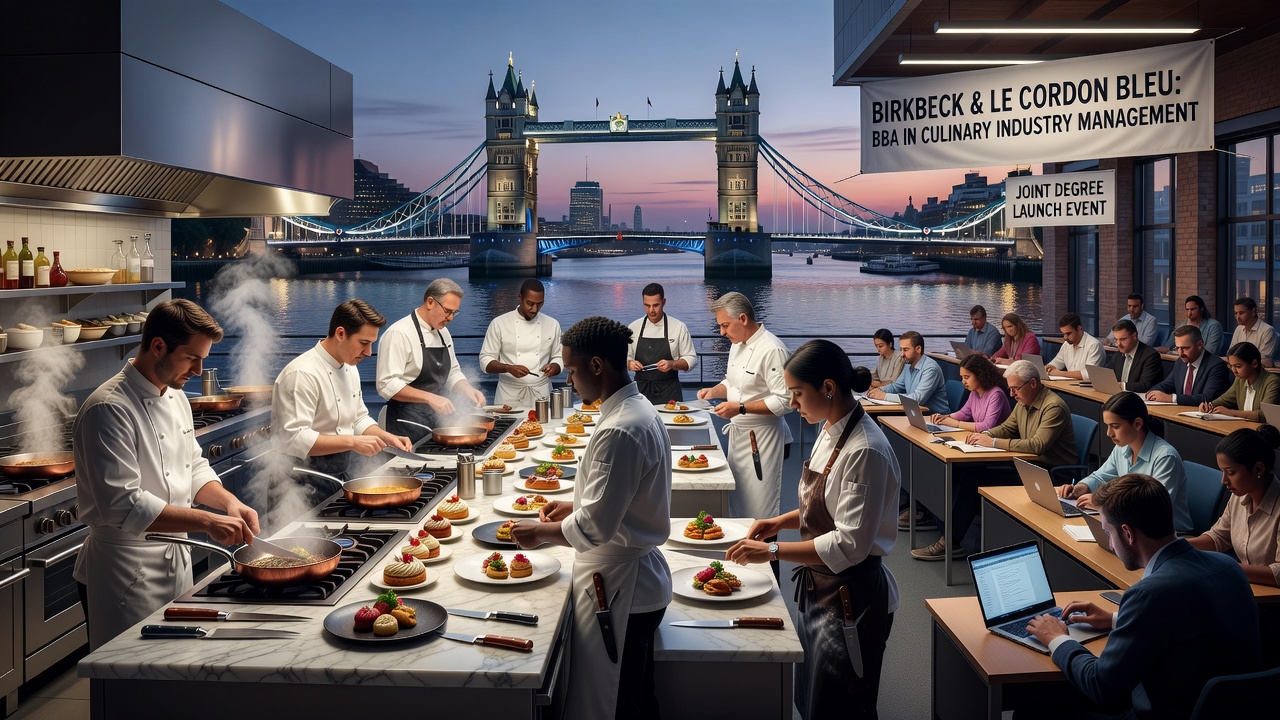
A joint undergraduate programme combining business education with professional culinary training has arrived in London, pairing Birkbeck, University of London, with Le Cordon Bleu Culinary Arts Institute. The BBA in Culinary Industry Management is described as the only degree of its kind in the UK, structured to produce graduates who understand both the kitchen and the boardroom of modern food businesses.
Why the pairing matters
Hospitality and food service have long suffered from a split in training: culinary schools teach technique, business schools teach management, and few institutions bridge the two. This degree attempts that bridge directly. Birkbeck brings its standing in management education, including research strengths in strategy, human resources and organisational governance. Le Cordon Bleu contributes classically trained chefs and dedicated culinary facilities. Students move between two London sites in close proximity, attending business modules at Birkbeck and professional practice sessions, including demonstrations and hands-on cooking, at Le Cordon Bleu.
The commercial logic is straightforward. Restaurants, hotel groups and catering operations increasingly need staff who can run a service and also read a profit-and-loss statement. Employers named in connection with the course, including the Savoy, Maybourne Hotel Group and Corinthia London, represent the higher end of UK hospitality, where operational complexity and commercial pressure both run high.
How the course actually works
The structure reflects the dual nature of the subject matter. Students typically take two classes at Le Cordon Bleu and two evening sessions at Birkbeck each week, with culinary teaching running from 6.30pm to 9.30pm in later years and from 3.00pm in the first year. Assessment mixes practical culinary examinations with the standard tools of a business degree: coursework, case studies, group projects and a final research project.
- Three-year full-time route requires 96-112 UCAS tariff points
- A four-year route with a Foundation Year is available for those needing additional preparation, requiring 64 points
- An internship between Years 1 and 2 is built into the programme, offered with industry partners
- English and mathematics at GCSE grade C/4 are normally expected, with alternative routes via a skills audit
The internship component deserves attention. Placing students with operators during the summer after first year gives them exposure to live kitchens and hospitality management before they complete their studies, a model more common in vocational training than in traditional degree courses.
What this signals for the hospitality sector
Hospitality has faced recurring difficulty recruiting management-track staff who stay in the industry long term. A degree that embeds professional culinary skill alongside formal business education addresses a recognised gap: chefs promoted into management roles without training in finance, operations or people management, and business graduates with no practical grounding in food service. Institute of Hospitality membership, offered free to students on the course, adds a further professional credential.
For prospective students, the practical considerations are significant. International applicants need a Student visa for study of this length and must attend full-time, on campus; part-time study is not available to those on a Student visa. Entry requirements are flexible by design, with Birkbeck stating it will consider applicants without traditional qualifications based on prior experience and academic potential, which widens access but also means outcomes will depend heavily on individual commitment across a demanding, multi-site timetable.