
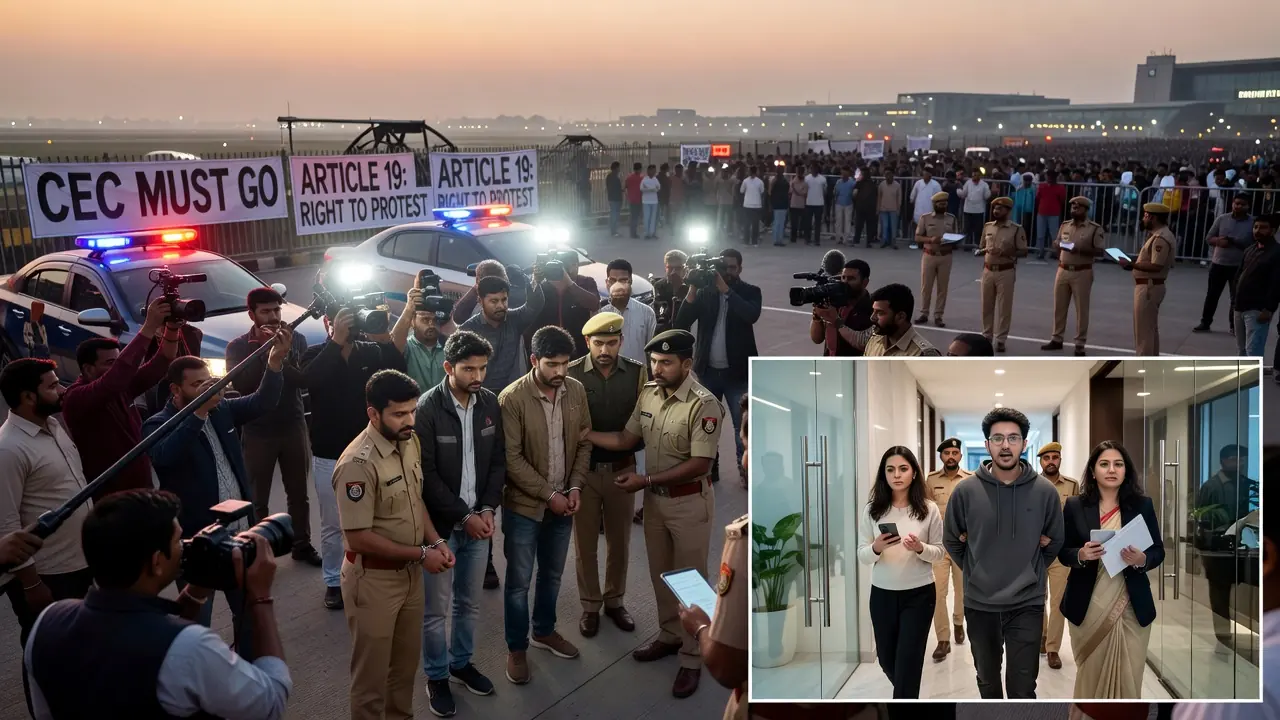
Police in Delhi moved before dawn against organizers of a planned demonstration calling for the resignation of Chief Election Commissioner Gyanesh Kumar. Activists Abhijeet Dipke, Saurav Das and Ashutosh Ranka were taken into custody directly from their flight shortly after it landed, according to video posted by the Citizens for Justice and Peace group they are associated with. YouTuber Dhruv Rathee was separately detained at his home in Gurugram, while influencer Kavya Karnatac and CJP legal head Ratna Singh were also picked up.
What the detentions signal
Delhi Police has stated that roughly 600 people have been detained in connection with the planned protest, with around 50 of those identified as having prior criminal records. The scale of the operation, carried out before the demonstration even began, raises a question that sits at the center of any functioning democracy: where is the line between maintaining public order and preventing citizens from exercising a right the Constitution explicitly protects? Article 19 of the Indian Constitution guarantees freedom of speech and the right to peaceful assembly, subject to reasonable restrictions that courts have historically interpreted narrowly rather than broadly.
Dipke's public challenge to the government before boarding his flight - inviting arrest and invoking his constitutional right to protest - now reads as prescient. Pre-emptive detention of organizers, rather than action taken during or after unlawful conduct, is a tactic that civil liberties lawyers and constitutional scholars have long scrutinized, because it shifts the burden from proving wrongdoing to simply preventing assembly altogether.
The political backdrop: why the CEC is the target
The protest's central demand concerns the conduct of Chief Election Commissioner Gyanesh Kumar, placing it squarely within debates over the independence and perceived neutrality of India's Election Commission. The Commission is constitutionally mandated to be insulated from political pressure, and any protest aimed at an individual holding that office inevitably touches questions of electoral integrity, voter confidence and institutional trust - issues that resonate well beyond the specific grievance at hand.
That a government response to a protest about election oversight should itself attract accusations of suppressing dissent is not a coincidence lost on commentators. Critics argue the response pattern - mass detentions, interception before protesters reach a public space, targeting of visible figures including a YouTuber with a large following - suggests concern less about traffic disruption and more about the optics and reach of the message being carried.
Implications for civil liberties and digital-age dissent
Rathee's detention is notable because his influence operates primarily through digital platforms rather than traditional political organizing. His case illustrates how content creators with large audiences are increasingly treated as political actors by state authorities, blurring the line between media commentary and activism. This has implications for how platforms, regulators and civil society understand accountability and protection for online speech in India going forward.
- Mass pre-emptive detention raises questions about proportionality under Article 19 protections.
- Targeting influencers and content creators signals an evolving state approach to digital-era dissent.
- Scrutiny of the Election Commission's leadership touches directly on public trust in electoral institutions.
- The response will likely be tested in courts, where India's judiciary has previously pushed back against overly broad restrictions on assembly.
How this situation unfolds will depend heavily on judicial review, media coverage and public reaction in the coming days. Whether the crackdown is framed by courts as a legitimate law-and-order measure or as disproportionate suppression of lawful dissent will shape precedent for how Indian authorities handle future protests tied to electoral accountability.