
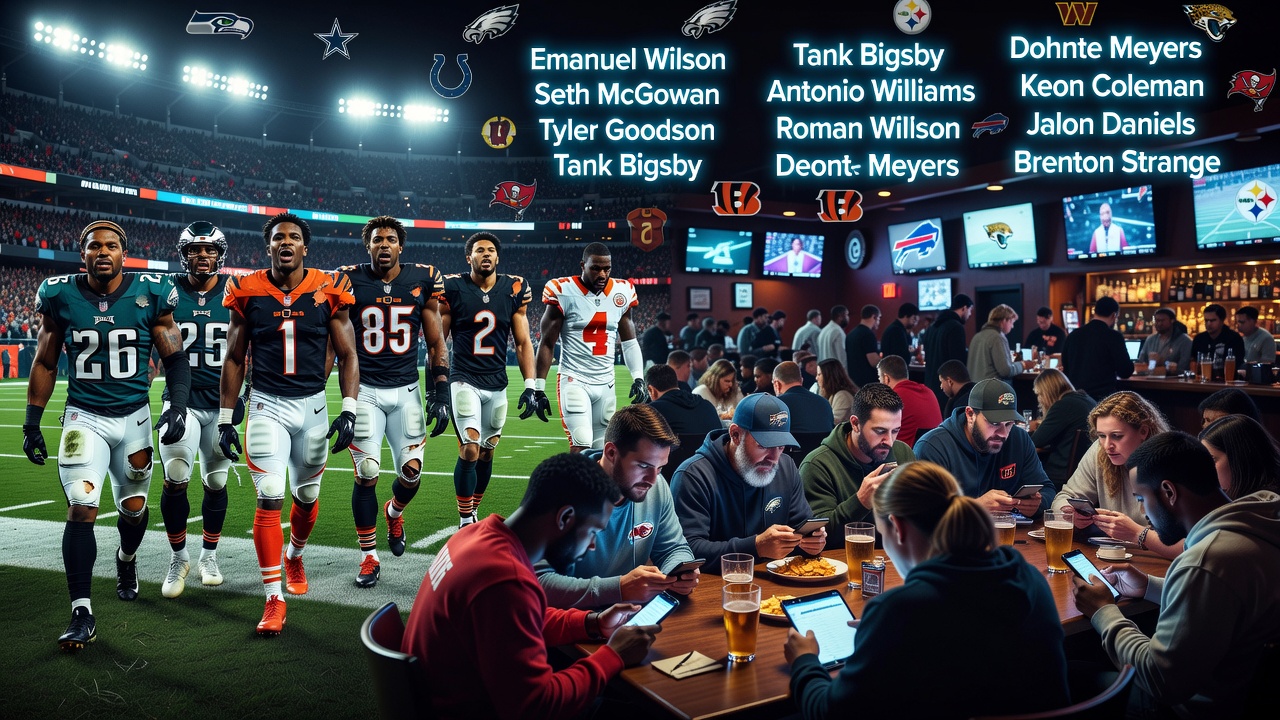
A second consecutive week of significant injuries to marquee skill-position players has scrambled fantasy football rosters across formats, forcing managers back onto the waiver wire for replacements. Saquon Barkley, Ja'Marr Chase, Tee Higgins, DJ Moore and Rashee Rice all exited games early, none of the setbacks appearing to be season-altering, but each immediately elevating a backup or complementary piece into relevant fantasy territory.
Why Backfield Depth Keeps Deciding Seasons
Running back remains the position where a single injury can flip an entire fantasy outcome overnight. When a bell-cow back goes down, the backup's workload share usually jumps immediately rather than gradually, which is why handcuff running backs carry outsized value relative to their modest price on waivers. Seattle's Emanuel Wilson, thrust into lead duties, posted strong volume across carries, catches and red-zone work - the kind of workload signal that typically holds up even after a timeshare eventually reasserts itself. Indianapolis' Seth McGowan and Dallas' Tyler Goodson represent a different category: handcuffs with little standalone value today but clear paths to relevance the moment the starter in front of them is sidelined. Philadelphia's Tank Bigsby sits between those two groups, already seeing real carries behind an injury-prone starter in Barkley.
Receiver Workload Tells a Deeper Story Than the Box Score
At wide receiver, raw stat lines can be misleading. Route participation and target share often predict future production better than a single big game does. Roman Wilson's touchdown-driven outburst in Pittsburgh came with a modest 16% target share, suggesting the floor remains shaky even if the ceiling looked tempting. By contrast, Washington's Antonio Williams and Buffalo's Keon Coleman posted far less dramatic box scores but commanded far more route share and targets, the underlying metrics that tend to sustain fantasy value week to week. Cincinnati's situation is particularly notable: with both Chase and Higgins banged up and a bye week approaching, a rookie such as Dohnte Meyers could inherit a genuinely significant workload for an extended stretch rather than a single game.
Reading Opportunity Correctly Matters More Than Chasing Box Scores
The tight end and quarterback waiver landscape this week reinforces a broader lesson for fantasy managers: situational opportunity, not a single highlight performance, is what should drive roster decisions. Jalon Daniels' rushing production in Tampa Bay came attached to an unspectacular overall line, and Jacksonville's Brenton Strange looked like a legitimate high-volume target earner for one week but faces a tougher matchup ahead. Treating waiver-wire activity as a probability exercise, rather than a reaction to one box score, is the more disciplined approach - and it mirrors the broader principle in any form of wagering or prediction-based activity that recent results alone rarely tell the full story.
What This Means for League Strategy Going Forward
Depth at running back, patience with rookie receivers showing strong underlying usage, and skepticism toward one-week touchdown spikes should guide waiver priorities through the middle stretch of the season. None of this guarantees outcomes - fantasy football, like most prediction-based entertainment, rewards informed judgment rather than certainty. Managers who track usage trends methodically, rather than chasing the previous week's scoring leaders, tend to build more durable rosters over a full season.