
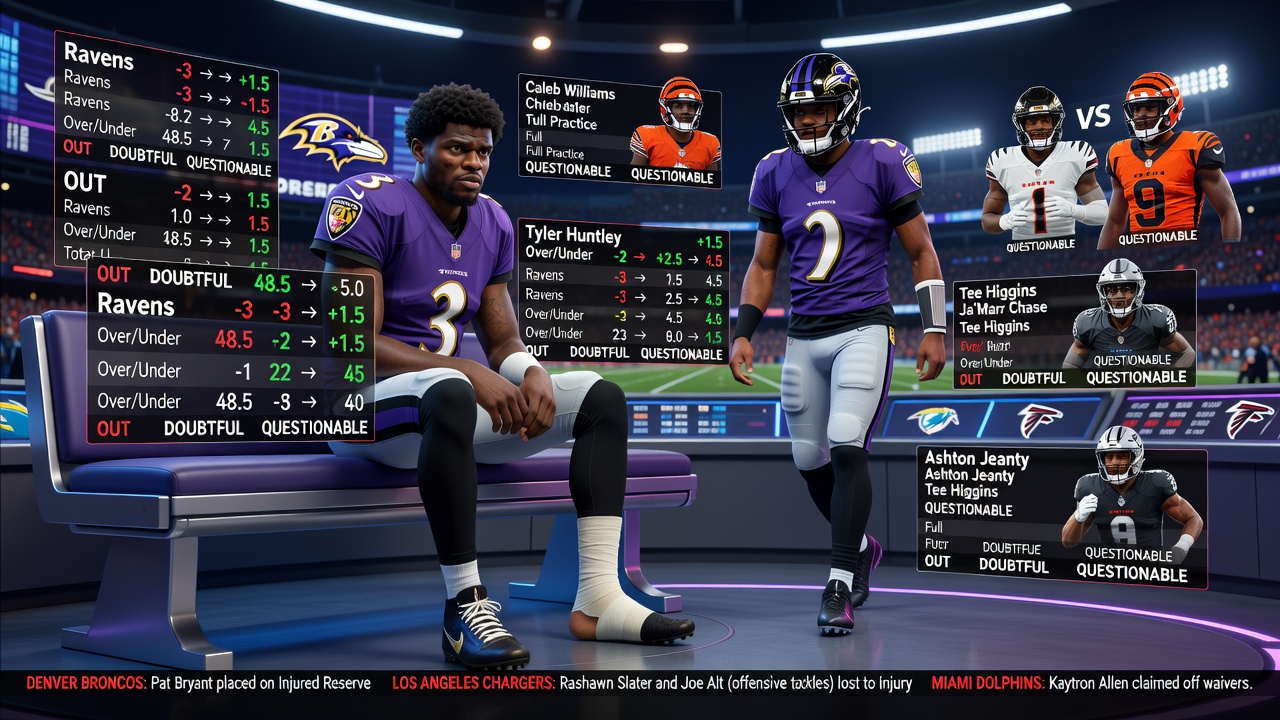
Lamar Jackson will not play Sunday night against Atlanta, a scratch that instantly alters how oddsmakers and bettors approach one of the week's marquee matchups. With Tyler Huntley stepping in for the Ravens, and a wave of other late-week designations touching nearly every team on the Week 5 slate, the NFL injury report has again become one of the most consequential documents in sports betting - arguably more influential on pricing than any single statistical trend.
Why Injury Reports Move Markets
Point spreads and totals are built on probability models, but those models are only as good as the information feeding them. A starting quarterback's absence, like Jackson's ankle injury, forces sportsbooks to recalibrate a game's entire pricing structure within hours. Books must balance speed against accuracy: react too slowly and sharp bettors exploit stale numbers; react too quickly on unconfirmed reports and the line itself becomes vulnerable to manipulation or error. This is why official designations - out, doubtful, questionable - carry regulatory and commercial weight, even though they originate from team communications rather than any gambling authority.
Questionable Tags and the Problem of Ambiguity
The murkiest category for consumers is "questionable." Chicago's Caleb Williams, Cincinnati's Ja'Marr Chase and Tee Higgins, and Las Vegas running back Ashton Jeanty all carry that label heading into Sunday, despite some being full practice participants. For bettors, this ambiguity is a genuine risk factor: a line built around a star receiver's expected absence can swing significantly if that player ultimately suits up. Sportsbooks' breakdown that treats the Friday injury report as directional, not definitive, reflects a deeper transparency gap in how player-availability information reaches the public compared with how it reaches teams and broadcast partners.
Roster Churn, Injured Reserve, and Market Depth
Beyond single-game pricing, the week's transactions - Denver placing Pat Bryant on injured reserve, the Chargers losing both Rashawn Slater and Joe Alt along the offensive line, Miami claiming running back Kaytron Allen off waivers - illustrate how roster depth shapes longer-term markets like win totals, division odds, and player props. The Chargers' accumulating injuries at 0-4, for instance, carry different implications for futures markets than a single questionable tag does for a Sunday spread. Operators that offer season-long or conference-level markets must continuously adjust not just for confirmed absences but for the compounding effect of attrition on a roster's competitive floor.
What This Means for Consumers
None of this information should be mistaken for a reliable edge. Public injury reports are widely available and already priced into markets well before most recreational bettors can act on them; professional operations and sportsbook trading desks process this data faster and more systematically than any individual. Responsible engagement with sports betting means recognizing that even perfect injury information does not remove the underlying uncertainty of outcomes - it only sharpens the probability estimate. Bettors should treat weekly transaction and injury news as context for understanding why lines move, not as a signal that guarantees an advantage.