
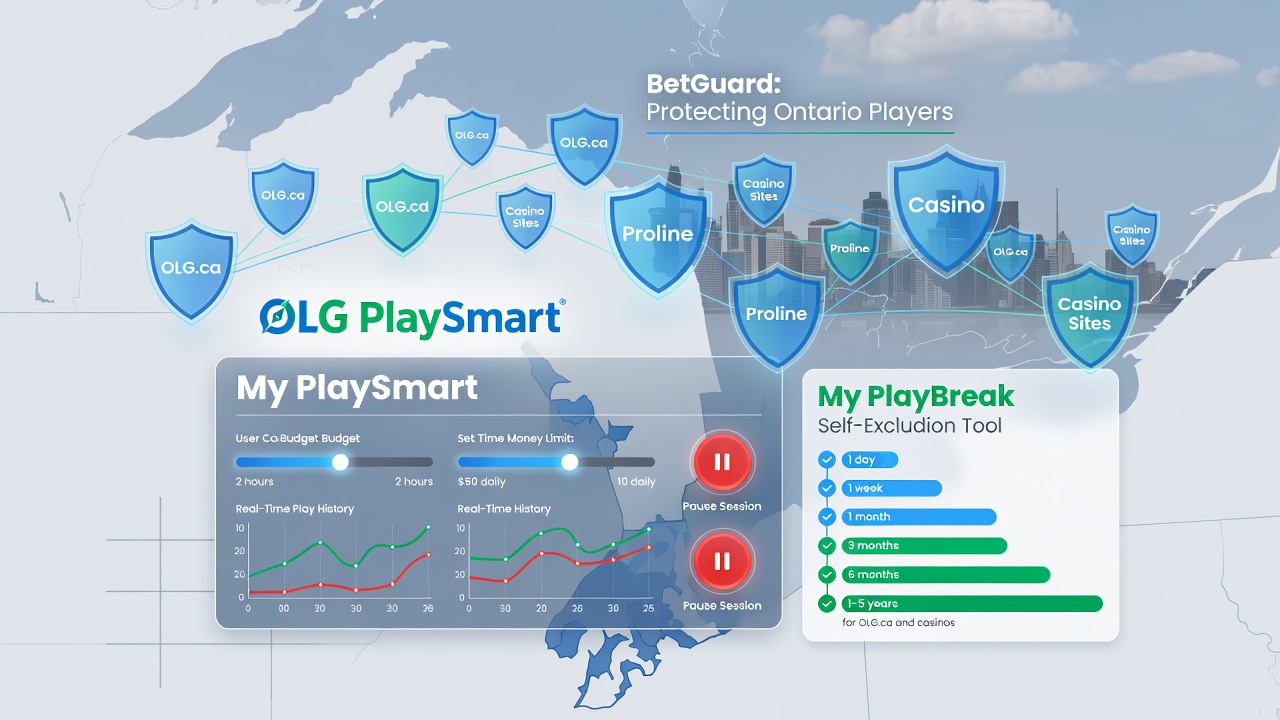
Ontario's regulated gambling market now includes a layered system of consumer protection tools, built and maintained by OLG under the PlaySmart banner. The framework combines education, self-management tools, and third-party accreditation, reflecting a broader shift in the gambling industry toward measurable, auditable responsible gambling programs rather than voluntary gestures.
Why Accreditation Matters More Than Marketing
Any operator can claim to support responsible gambling. What distinguishes OLG's approach is external verification. RG Check, an internationally recognized certification program, has covered all OLG casinos and OLG.ca since 2018. Separately, the World Lottery Association has certified OLG at its highest tier since 2010, and in 2022 OLG became the first Canadian lottery certified by the North American Association of State and Provincial Lotteries and National Council on Problem Gambling program at its top level. These certifications require periodic re-evaluation, meaning the standards are not a one-time badge but an ongoing compliance obligation. For a regulator-owned operator like OLG, this matters because it sets a benchmark that private operators entering Ontario's market are implicitly measured against.
Practical Tools: My PlaySmart and My PlayBreak
Beyond accreditation, the practical value for players lies in the tools themselves. My PlaySmart lets users set personal budgets for time and money spent, review their own play history, and pause activity when needed. It also extends to slot machines at select Ontario casinos, bridging digital and physical gambling environments under one framework.
My PlayBreak is OLG's self-exclusion mechanism, distinct from a simple account deactivation. Players select a break length and articulate personal goals, receiving structured support during the exclusion period. Duration options are notably granular:
- Casinos or Charitable Gaming Centres: 3 or 6 months, or 1 to 5 years
- OLG.ca: 6 months to 5 years, plus shorter options of 1 day, 1 week, 1 month, 2 months or 3 months
That flexibility acknowledges a real behavioral pattern: players who want a brief cooling-off period have different needs than those seeking a multi-year break, and forcing everyone into the same rigid structure tends to reduce uptake of self-exclusion tools generally.
BetGuard and the Limits of Self-Exclusion
A gap in most self-exclusion systems is scope - a player can shut out one operator while still accessing others. BetGuard addresses this by covering all regulated digital gambling sites in Ontario, not just OLG properties, through exclusion periods ranging from six months to five years. This province-wide approach reflects a recognition, increasingly common among gambling regulators, that single-operator self-exclusion is only partially effective when a jurisdiction hosts multiple licensed platforms. It's worth noting the tool has a clear boundary: BetGuard does not extend to land-based casinos, and enrolling requires setting up a separate profile outside the OLG ecosystem.
Physical Touchpoints Still Matter
Despite the digital push, OLG maintains PlaySmart Centres at every casino and Charitable Bingo & Gaming Centre in the province, operated jointly with the Responsible Gambling Council. These spaces offer printed materials, digital resources, and direct pathways to problem gambling support - a reminder that responsible gambling infrastructure still needs an in-person presence for players who don't primarily interact with these services online. A virtual version of these centres extends the same resources to digital-only players.
What This Means for the Market
As Ontario's regulated online gambling market continues to mature, tools like these function as both consumer protection and competitive differentiation. Third-party accreditation, granular self-exclusion options, and cross-operator programs like BetGuard set a template that other Canadian jurisdictions - and private operators competing in Ontario - will likely be measured against as regulatory scrutiny of the sector intensifies.