
Online Casino Legality in India: Indian Gambling Laws, Regulations, and Licensed Online Casinos
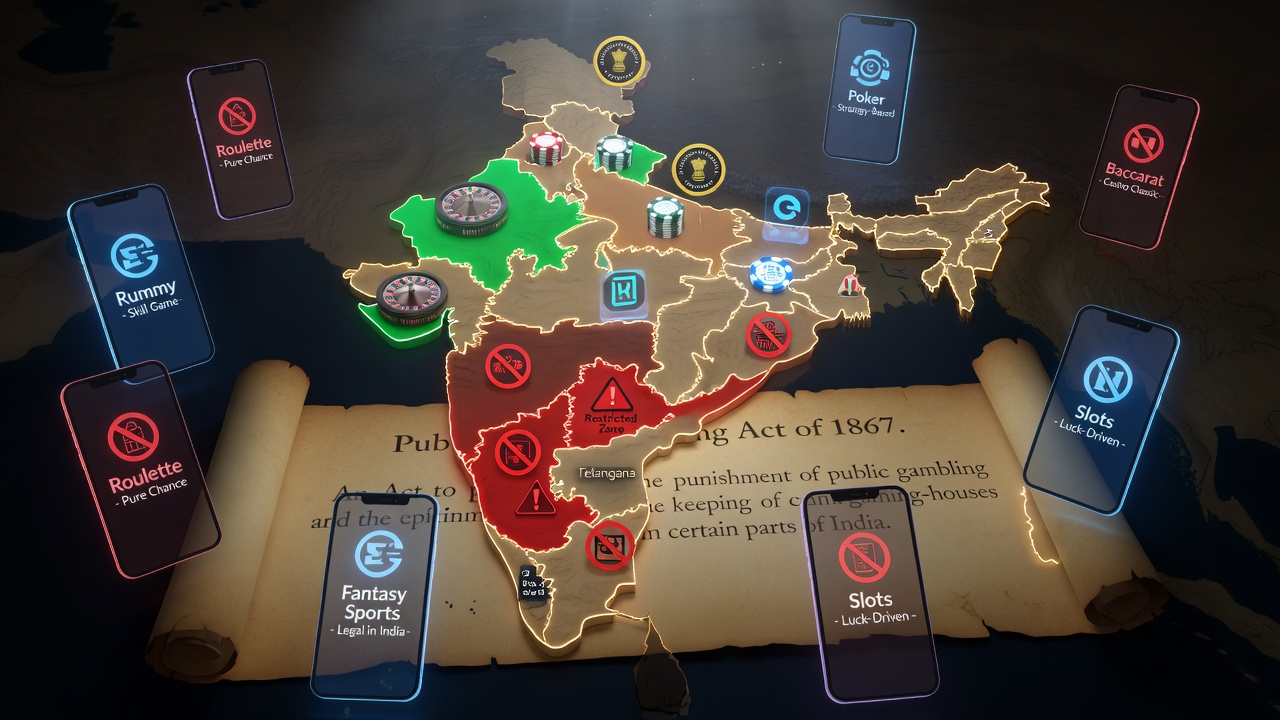
India has no single national law that bans or permits online casinos. That gap has created one of the most fragmented gambling markets in the world, where a player in Goa can legally sit down at a physical roulette table while a resident of Andhra Pradesh faces criminal liability for placing an online bet from a smartphone. This patchwork exists because gambling regulation in India falls under state jurisdiction, not central government control, and each state has written its own rules - some strict, some silent, some openly permissive.
The confusion around online casino legality in India stems largely from a colonial-era statute that predates the internet by more than a century. The Public Gambling Act of 1867 governs physical gambling houses but says nothing about digital platforms, leaving courts and lawmakers to argue over how - or whether - it applies online. For anyone trying to determine whether a specific platform operates within the law, the clearest starting point is a dedicated legal breakdown; in fact, one detailed resource explains precisely why online casino in india is legal in certain states while remaining prohibited in others, based on how each jurisdiction has chosen to legislate skill-based and chance-based gaming. Understanding this distinction is the foundation for everything that follows.
This article breaks down the legal architecture state by state, examines the regulatory bodies attempting to bring order to the sector, and identifies what separates a licensed operator from an unregulated one. Readers who want a practical, accurate picture of where they stand legally - and how to gamble online without exposing themselves to financial or legal risk - will find every relevant angle covered here.
Understanding the Legal Framework Behind Online Casino Legality in India
Gambling law in India operates on two levels: a colonial framework that never anticipated digital wagering, and a constitutional structure that hands states the power to legislate on betting and gambling within their borders. The result is a system where legality shifts depending on where a player physically sits when they place a bet, not where the casino server is located.
The Public Gambling Act of 1867 and Its Limitations
The Public Gambling Act criminalizes running or visiting a "common gaming house," a term drafted for physical premises long before anyone imagined a casino existing on a server. Courts have repeatedly struggled to apply this language to websites and apps. Because the Act never explicitly mentions online platforms, several state governments have either amended it locally or left the question to newer, purpose-built legislation.
State Jurisdiction Under the Constitution
Entry 34 of the State List in the Indian Constitution assigns "betting and gambling" to state governments. This is the single most important fact for understanding Indian gambling laws online casino operators must navigate. A state like Sikkim can license and tax online gaming, while a neighboring state can prohibit it outright, and both actions are constitutionally valid.
Skill-Based Games vs Games of Chance
Indian courts have long distinguished between games requiring predominant skill and those relying purely on chance. Rummy and fantasy sports have received judicial protection as skill-based activities in several rulings, while games like roulette, slots, and baccarat are treated as chance-based and therefore fall under stricter gambling restrictions in most states.
- Games of skill: rummy, poker (in select states), fantasy sports
- Games of chance: roulette, slots, baccarat, most traditional casino games
- Hybrid disputes: certain card games remain contested in court depending on state interpretation
Is Online Casino Legal in India? A State-by-State Breakdown
There is no single answer to whether online casino play is legal in India - the honest answer is "it depends on the state." This section maps out where players face the least legal exposure and where the risks are genuinely serious.
States With Explicit Legalization: Sikkim and Nagaland
Sikkim was among the first states to legislate specifically for online gambling, issuing licenses under the Sikkim Online Gaming (Regulation) Rules. Nagaland followed with the Nagaland Prohibition of Gambling and Promotion and Regulation of Online Games of Skill Act, which distinguishes and permits skill-based online games under license. Both frameworks were built with digital platforms in mind, unlike the 1867 Act.
States With Explicit Bans: Telangana, Andhra Pradesh, and Others
Telangana and Andhra Pradesh have gone the opposite direction, amending their gambling laws to explicitly criminalize online betting and gaming, including skill-based formats that remain legal elsewhere. Tamil Nadu has also introduced restrictions targeting online gambling and real-money gaming apps. Players in these states face direct legal consequences for participation, not just the operators.
Grey Areas: States With No Specific Online Gambling Legislation
The majority of Indian states have never updated their gambling statutes to address online platforms at all. In these regions, the legal position is ambiguous - neither clearly permitted nor explicitly banned. This grey zone is where most Indian players actually reside, and it is also where confusion about is online casino legal in India runs highest, since enforcement is inconsistent and rarely targets individual players.
Indian Gambling Laws Online Casino Operators Must Follow
Operators face a different - and generally heavier - compliance burden than individual players. Running a platform without meeting jurisdictional requirements exposes a company to shutdown orders, asset seizure, and criminal prosecution of its executives.
Licensing Requirements for Domestic Operators
Any operator wishing to legally serve Indian players from within the country must obtain a license from a state authority that permits online gaming, such as Sikkim or Nagaland. These licenses typically require proof of fair-play mechanisms, financial guarantees, server location disclosures, and regular audits.
Offshore Operators and the Jurisdictional Grey Zone
Many platforms accessible to Indian players are licensed offshore - commonly in Curaçao, Malta, or the Isle of Man - and operate outside direct Indian jurisdiction. Indian law generally cannot prosecute a foreign-licensed company for accepting bets from Indian users, which is why offshore platforms dominate the market despite the domestic legal ambiguity.
Taxation Obligations Under the GST Framework
Since October 2023, India applies a 28% Goods and Services Tax on the full face value of bets placed on online gaming platforms, including casino-style games. This tax applies regardless of whether the game is classified as skill or chance, marking one of the more aggressive tax regimes globally for online gambling revenue.
Regulations for Online Casinos in India: What Compliance Actually Looks Like
Beyond licensing, genuine regulatory compliance involves a set of operational standards that separate legitimate platforms from fly-by-night operations designed to disappear with player funds.
Age Verification and KYC Mandates
Legitimate platforms enforce a minimum age of 18 (21 in some states) and require Know Your Customer verification using government-issued identification such as Aadhaar or PAN. This isn't just a formality - it's the primary mechanism preventing underage access and enabling traceable financial transactions.
Anti-Money Laundering Standards
Regulated operators must implement transaction monitoring systems consistent with the Prevention of Money Laundering Act. This includes flagging unusual deposit patterns, setting withdrawal limits, and reporting suspicious activity to financial intelligence authorities - obligations that unregulated offshore sites routinely ignore.
Responsible Gambling Provisions
Regulations for online casinos in India increasingly mandate self-exclusion tools, deposit caps, and mandatory break reminders. Nagaland's licensing framework, for instance, requires operators to display responsible gambling messaging and provide access to support resources for players showing signs of compulsive behavior.
How to Identify Licensed Online Casinos in India
With hundreds of platforms marketing themselves to Indian players, distinguishing a properly licensed casino from an unregulated one requires checking specific, verifiable details rather than trusting marketing claims.
Checking License Authenticity and Jurisdiction
A genuine license number should be verifiable directly on the licensing authority's official registry - whether that's Sikkim's gaming department, Nagaland's regulatory body, or an offshore authority like Malta Gaming Authority or Curaçao eGaming. If a platform cannot produce a checkable license number, treat that as a serious warning sign.
Payment Security and Fund Segregation
Licensed operators are typically required to keep player funds in accounts segregated from operational capital, protecting deposits even if the company faces financial trouble. Look for platforms that support recognized payment methods with encryption standards and transparent withdrawal timelines.
Red Flags of Unlicensed or Fraudulent Platforms
- No visible license number or jurisdiction disclosure
- Unusually high bonuses with vague or missing wagering terms
- No functioning customer support channel
- Withdrawal delays with no clear explanation or timeline
- Absence of responsible gambling tools or age verification at signup
Risks and Consequences for Players Betting on Unregulated Platforms
Choosing an unregulated platform isn't a purely theoretical risk - it carries concrete financial and, in certain states, legal consequences that players often underestimate.
Financial Risks: Non-Payment and Data Theft
Unlicensed operators face no external audit requirement, meaning there's no guarantee winnings will be paid out. Player data submitted during registration - including financial details - can also be mishandled or sold, since these platforms operate outside any data protection enforcement mechanism.
Legal Exposure in States With Strict Gambling Bans
Players in Telangana, Andhra Pradesh, and similar states can face fines or prosecution simply for placing bets online, regardless of where the operator is based. Enforcement has historically focused on larger operations, but individual liability technically exists under these state laws.
Why Licensing Status Should Guide Every Decision
Verifying licensing status before depositing a single rupee is the single most effective safeguard a player has. It determines whether disputes have any path to resolution, whether funds are protected, and whether the platform is accountable to any regulatory body at all.
Frequently Asked Questions
Can I go to jail for playing at an online casino in India?
Criminal liability for individual players is rare and largely limited to states like Telangana and Andhra Pradesh, which have explicit bans covering online betting. In most other states, enforcement targets operators rather than individual users, though the legal risk technically exists wherever bans apply.
Which Indian states have the clearest legal framework for online casinos?
Sikkim and Nagaland have the most developed frameworks, having passed specific legislation to license and regulate online gaming platforms. Both states issue licenses with defined compliance requirements, unlike states that rely on the outdated 1867 Public Gambling Act.
Are offshore online casinos safe for Indian players?
Safety depends entirely on the offshore license's credibility. Platforms licensed by established authorities like Malta Gaming Authority or Curaçao generally maintain audited fairness standards and fund protection, while sites with no verifiable license carry substantial financial risk.
Do I have to pay tax on my online casino winnings in India?
Yes. Winnings from online gambling are taxed at a flat 30% rate under Indian income tax law, with no deductions or exemptions allowed, separate from the 28% GST charged on the platform's betting turnover.
How can I verify if a casino license is genuine?
Search the license number directly on the issuing authority's official website or registry - legitimate regulators maintain publicly searchable databases. If the platform's license number doesn't match any entry, or the operator refuses to disclose it, that's a strong indicator of an unlicensed operation.
Will India introduce a national online gambling law?
There have been ongoing policy discussions at the central level about creating unified regulation for online gaming, partly driven by taxation and consumer protection concerns. No comprehensive national gambling law has been enacted yet, so the state-by-state system remains in effect for the foreseeable future.