
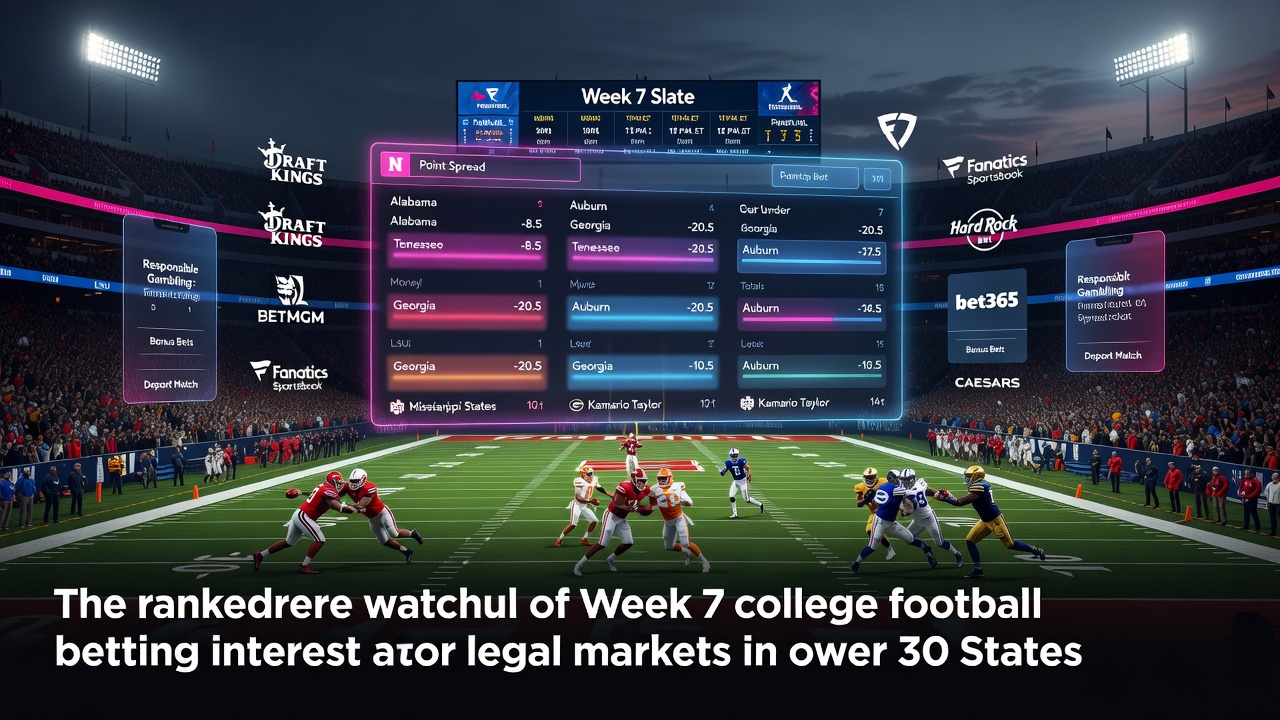
Six ranked-versus-ranked games headline Saturday's Week 7 college football slate, led by No. 1 Georgia hosting Auburn, No. 6 Alabama traveling to No. 14 Tennessee and No. 2 Notre Dame facing No. 8 BYU on the road. The breadth of the schedule, spanning noon kickoffs through an 11 p.m. ET finale between Nebraska and Oregon, illustrates how the legal sports betting market has expanded alongside college football's own growth into a near round-the-clock television product.
A market built on volume and competition
Sports betting is now legal and operational in more than 30 states plus Washington, D.C. and Puerto Rico, and that expansion has reshaped how operators compete for customers. DraftKings, FanDuel, BetMGM, Caesars, bet365, Hard Rock Bet and Fanatics Sportsbook all continue to run new-user promotions well into the season, a sign that customer acquisition remains central to their business models even after the initial legalization wave has settled. These offers typically take the form of bonus bets tied to an initial wager, rather than free money with no conditions attached, and the exact terms, minimum deposits, wagering requirements and expiration windows vary by operator and by state.
What the odds actually represent
Point spreads, moneylines and over/under totals are pricing mechanisms set by sportsbooks to balance action on both sides of a game, not predictions of outcome. Alabama as an 8.5-point road favorite over Tennessee, or Georgia as a 20.5-point favorite over Auburn, reflects market consensus shaped by team performance, injuries and public betting patterns, including news like Mississippi State quarterback Kamario Taylor's injury status shifting the LSU line from 10.5 to 14 points. These numbers move throughout the week as books manage their liability, which is why the betting guide snapshot of lines can differ from what a bettor ultimately sees at kickoff.
Reading promotional offers with a clear eye
Bonus bets and deposit-matched credits are marketing tools designed to encourage account funding and repeat engagement, and they come with structural conditions worth understanding before signing up. Bonus bets generally cannot be withdrawn directly as cash, often require a minimum odds threshold to qualify, and must be wagered before any winnings become withdrawable. None of this changes the underlying math of sports betting: the house maintains a structural edge through the vig built into odds, and no promotion, trend analysis or betting system guarantees profit over time. Understanding spreads, totals and moneylines is useful for following a game intelligently, but it does not offset the inherent uncertainty of outcomes like whether Georgia's defense holds Auburn under 20 points or whether Texas can slow Florida's rushing attack.
Context for bettors and the industry alike
For consumers, the practical takeaway is that promotional offers and betting guides are consumer-facing content tied to a competitive, heavily marketed industry, and treating them as entertainment spending rather than income strategy is the standard responsible-gambling framing regulators and operators themselves endorse. For the industry, the proliferation of in-season offers across major ranked matchups signals how much operators rely on live sports calendars, especially college football's conference-driven Saturday structure, to drive registrations and sustained engagement throughout the season.