
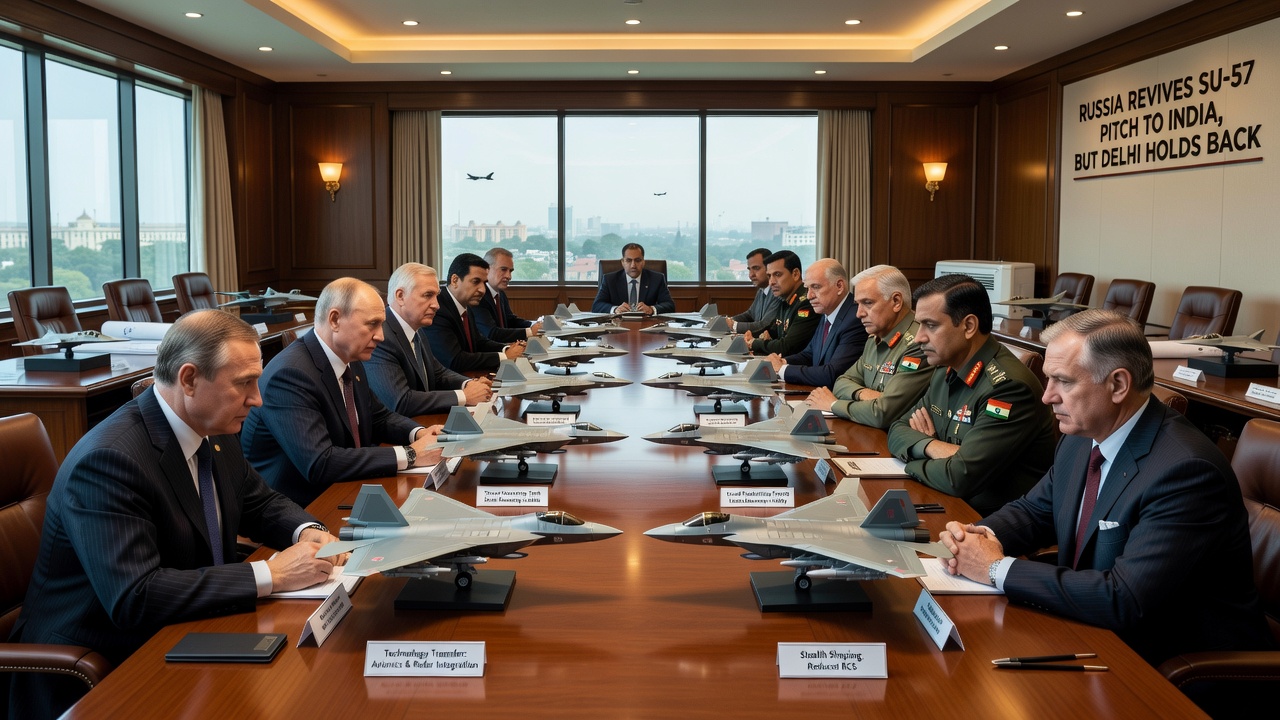
Moscow is again courting New Delhi with its Su-57 stealth fighter, dangling technology transfer and local production as sweeteners. India, however, has shown little appetite for revisiting an aircraft it walked away from once already. The renewed pitch says as much about Russia's defense-export pressures as it does about India's own ambitions.
A Partnership That Already Failed Once
India and Russia once worked jointly on a fifth-generation fighter under the FGFA programme, an Indian variant tied to the Su-57's development. Delhi exited in 2018, citing dissatisfaction with the jet's stealth characteristics, engine performance, and the overall cost of the project. Those concerns were not minor technical quibbles. Stealth shaping, radar cross-section, and engine thrust-to-weight ratios are the core attributes that define whether a fighter can genuinely compete in the fifth-generation category, and India's assessment at the time was that the Su-57 fell short on several of these fronts relative to what it needed.
That exit left a trust deficit. Rebuilding a defense partnership after a public withdrawal requires more than a renewed sales pitch; it requires addressing the original objections with evidence, not assurances.
Production Numbers and a Contested Combat Record
Since 2018, the Su-57 has struggled to shake off questions about how many aircraft Russia has actually built and delivered to its own air force, let alone for export. Production has been slower than initially advertised, and the aircraft's operational history, including its use in the war in Ukraine, has drawn scrutiny rather than confidence. Reports of limited or cautious deployment have fueled skepticism about whether the jet performs as a true fifth-generation platform under contested airspace conditions. For a buyer like India, which operates in a complex security environment facing two nuclear-armed neighbors, an unproven combat record is a serious liability, not a footnote.
Export credibility in the fighter jet market rests heavily on demonstrated performance. Buyers want evidence of reliability, sustained production capacity, and a support ecosystem for spare parts and upgrades. Ambiguity on any of these fronts makes a sales pitch harder to sustain, regardless of the political relationship between the two countries.
Why Russia Keeps Pushing
Russia's defense industry has strong incentives to keep the Su-57 offer alive. Export sales help fund continued development and production, especially as Western sanctions limit Moscow's access to other markets and components. Framing the aircraft as a bridge solution until India's indigenous Advanced Medium Combat Aircraft (AMCA) is ready is a pragmatic sales argument: it positions the Su-57 not as a competitor to India's long-term ambitions but as a stopgap that fills a capability gap in the interim.
The offer of technology cooperation and local production also plays to India's long-standing preference for self-reliance in defense manufacturing. Yet India has heard similar promises before, and the FGFA experience left lingering doubts about how much genuine technology transfer would actually materialize in practice.
The AMCA Factor
India's own fifth-generation ambitions now center on the AMCA, a domestically developed stealth fighter still years from operational deployment. Committing to a foreign platform like the Su-57 in the interim could complicate funding, industrial focus, and political commitment to the AMCA programme. Delhi appears to be betting that patience with its own project, even with the capability gap it creates in the near term, is preferable to re-entering a partnership that previously failed to meet its technical and strategic expectations.
This is ultimately a story about trust, timelines, and the economics of defense procurement. Russia needs the sale. India needs a credible platform. Those two needs have not yet found common ground.