
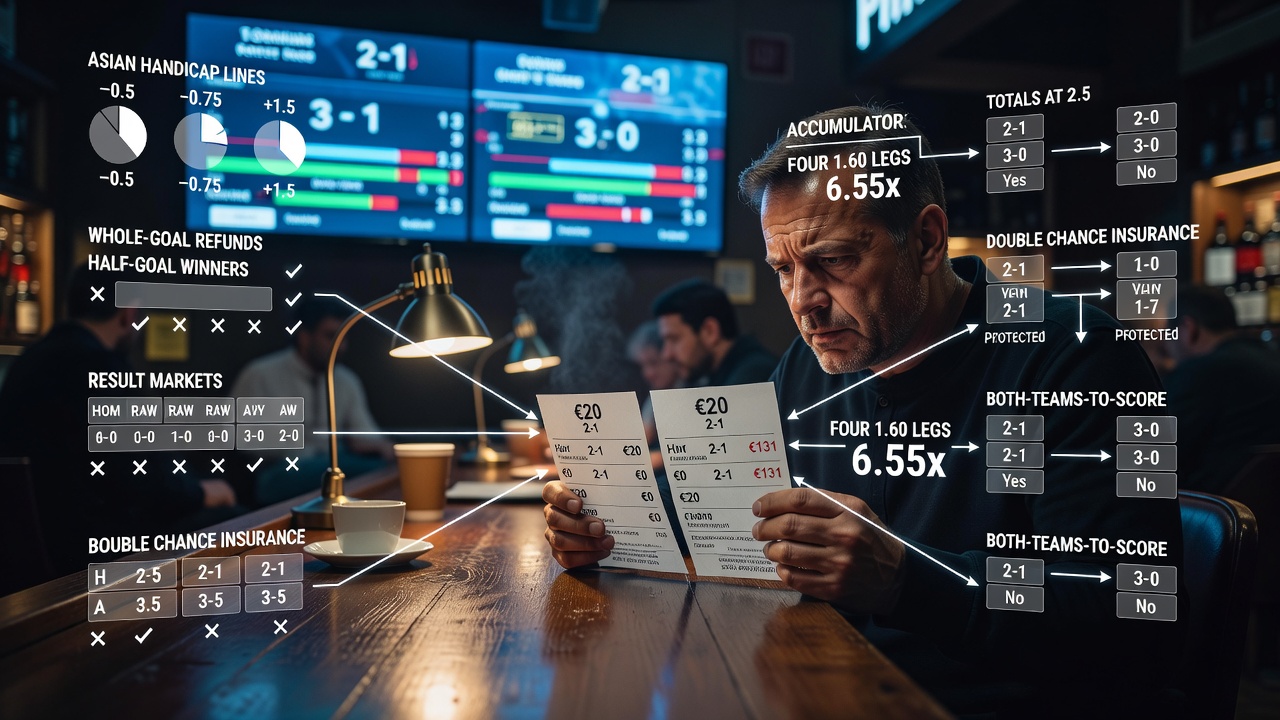
A bettor who misreads the difference between a half-goal line and a whole-goal line can lose money on a wager they technically won. Settlement rules, not just odds, decide what a slip actually pays, and small print varies by market and by operator. Understanding the mechanics behind common bet types is the only way to know what a given stake is really buying.
Result markets and the price of safety
Football's three-way result market - home, draw, away - exists because a draw is a real outcome, unlike in sports that use a two-way moneyline. Double chance markets merge two of those three outcomes into a single bet, which mechanically lowers the odds because the bettor is backing a wider slice of possibilities. A €20 stake on an away win at odds of 3.40 returns €68 if the team wins outright. The same €20 on "draw or away" at 1.70 returns €34. The bettor hasn't lost accuracy, they've bought insurance against one specific outcome, and insurance costs money in the form of reduced returns.
Handicaps: where a quarter-point changes everything
European handicaps add a goal buffer but keep the draw alive as a separate result. Asian handicaps remove the draw entirely. Half-goal lines such as −0.5 or +1.5 always produce a winner because a draw on a half-number is mathematically impossible. Whole-goal lines refund the stake if the match ties exactly on that number. Quarter lines - −0.25, −0.75 - split the stake across two neighbouring lines, which is where confusion usually starts. A €20 bet at −0.75 and odds of 2.00 illustrates the mechanism: a win by two or more goals settles both halves as winners, returning €40. A win by exactly one goal settles half as a win and refunds the other half, returning €30 total. Two slips with the same odds and the same scoreline can therefore produce different payouts depending on the line type.
Totals, both-teams-to-score, and the detail that trips people up
Totals markets ignore who wins and focus purely on a combined count - goals, points, corners, games. A half-point total like 2.5 cannot push; it's a win or a loss, nothing else. Whole-number totals can refund the stake if the match lands exactly on the line. What counts toward that total is not always obvious - own goals are usually included, penalty shoot-outs usually excluded, but this varies and is worth checking before assuming. "Both teams to score" works on a similar principle of narrow definition: a 2-1 result pays, a 3-0 result does not, regardless of which side wins. Combined markets that bundle both-teams-to-score with a result or total typically carry a higher built-in margin than either market sold separately, which is a cost worth noticing rather than a bonus worth chasing.
Accumulators, system bets, and compounding risk
An accumulator multiplies odds across legs, and that multiplication cuts both ways. Four legs priced at 1.60 each combine to roughly 6.55, turning a €10 stake into a €65.54 return if every leg wins. But probability also compounds: four independent 60% chances land together only about 13% of the time, and the operator's margin is applied on every single leg, not just once. System bets such as a Trixie spread the same selections across multiple smaller combinations, so one losing leg doesn't void the entire slip - though the bettor pays for more combinations upfront, raising the total stake required.
In-play speed, cash-out, and the regulatory backdrop
Live betting prices move continuously, and operators routinely delay bet acceptance by a few seconds to guard against bettors exploiting faster data feeds than the book itself uses. Cash-out offers an exit before settlement, but that price embeds its own margin and can be suspended around pivotal moments - it is a conditional feature, not a fixed right. In Slovenia, betting falls under the Zakon o igrah na srečo, which makes organising games of chance an exclusive state right exercised through government-licensed concession holders. FURS supervises the sector, unlicensed operation is prohibited, and courts can order internet providers to block access to non-compliant sites. Anyone checking whether a given platform holds a Slovenian concession should consult the public list on the Ministry of Finance's site directly rather than assume. Outside Slovenia, local licensing rules apply, and they differ meaningfully between jurisdictions.