
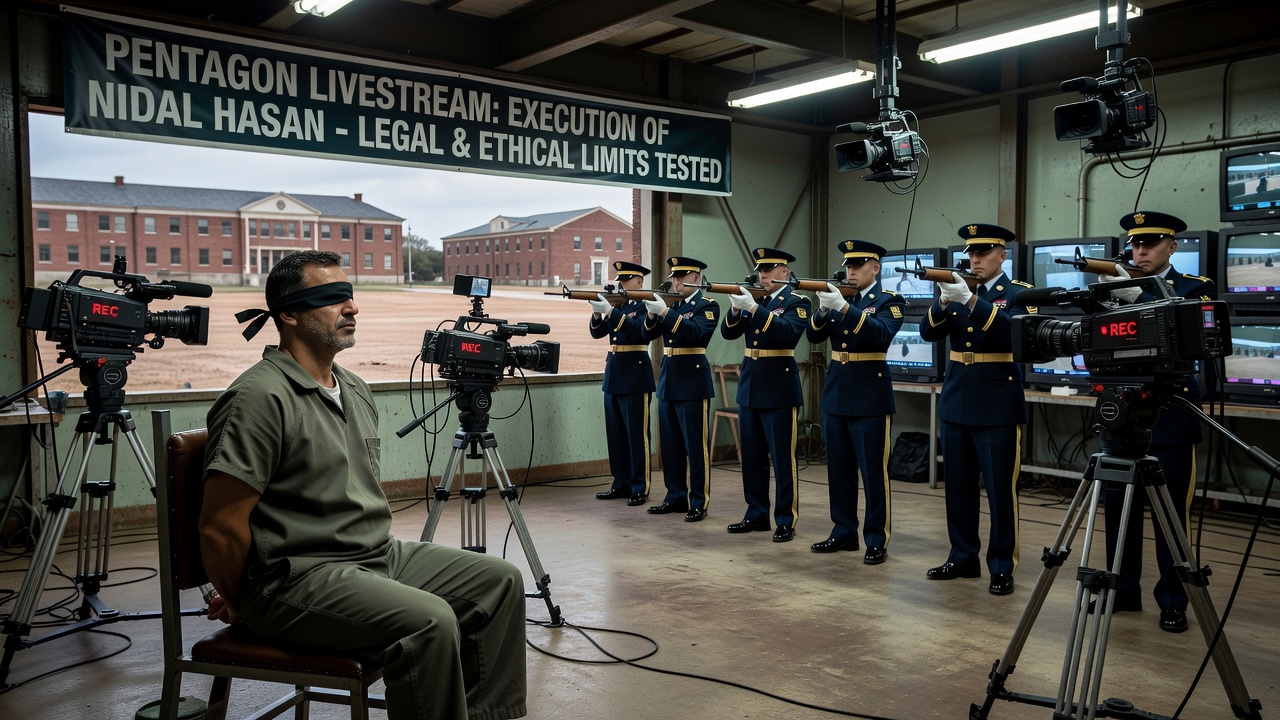
The Department of Defense says it intends to broadcast the execution of Nidal Hasan, the former US Army major who killed 13 unarmed soldiers at Fort Hood in 2009, by firing squad. If carried out as described, it would mark the first public execution on US soil in roughly a century. The announcement raises questions that go well beyond this single case, touching on military law, federal execution protocol, and the patchwork of rules that govern whether and how an execution can ever be filmed.
Why military executions follow a different rulebook
Hasan was convicted by a military court-martial, which places his case under the Uniform Code of Military Justice rather than civilian federal or state law. Military executions are exceedingly rare and have historically been subject to layers of review, including presidential approval, before a sentence can be carried out. This separate legal track matters because it means the Pentagon is not bound by the same statutes that govern executions in, say, Texas or the federal Bureau of Prisons. Where civilian jurisdictions have built decades of case law around media access and execution witnesses, the military has almost no modern precedent to draw on, since it has not carried out an execution in over sixty years.
What the law actually says about filming executions
Across US jurisdictions, the default position has been restriction rather than openness. Federal and state execution protocols typically allow a small number of official witnesses, victims' family members, and credentialed journalists into the chamber, but cameras, recording devices, and live broadcast have been barred in virtually every case for decades. Courts have repeatedly rejected efforts by media organizations to film executions, citing concerns about dignity, security, and the risk of sensationalizing a legally mandated death. Military regulations on this point are far less tested, which is precisely why legal scholars are watching this case closely. Any attempt to livestream would likely face immediate legal challenges from advocacy groups, defense attorneys, or media law experts arguing it conflicts with established constitutional and procedural safeguards, even if the military claims authority to set its own terms.
The broader stakes of broadcasting state-sanctioned death
A livestreamed execution would collide with long-standing norms in American justice administration, where even routine court proceedings are often shielded from cameras. The debate is not simply technical. It touches on how institutions weigh transparency against the risk of turning an execution into spectacle, and how footage, once released into digital circulation, cannot be contained or withdrawn. Historically, the shift away from public executions in the early twentieth century was driven by concerns that public spectacle undermined the solemnity and order the justice system claims to uphold. Reintroducing a livestream, even for a case as widely condemned as the Fort Hood attack, reopens that unresolved tension between public accountability and the ethics of broadcasting death.
What happens next
No formal date or method for releasing any footage has been confirmed, and the legal authority for a livestream remains unsettled. Expect scrutiny from civil liberties organizations, military law specialists, and possibly federal courts before any broadcast could proceed. The case will likely become a reference point for how military and civilian execution protocols differ, and whether either system is equipped to handle the technological reality of instant, uncontrollable digital distribution.