
Asian Handicap betting has quietly become one of the most technically sophisticated products in football wagering, built on a simple premise: remove the draw, and you remove a third of the uncertainty that makes standard 1X2 markets harder to price efficiently. By assigning a virtual goal advantage or deficit to one side before kick-off, the market forces a binary outcome between favourite and underdog - but the mechanics behind how that handicap is applied reveal a level of mathematical nuance most bettors never fully grasp.
Why Removing the Draw Changes the Calculation
Standard 1X2 betting splits probability across three outcomes - home win, draw, away win - which inflates the bookmaker's margin relative to a two-way market. Asian Handicap collapses that into two outcomes by handing the stronger side a notional deficit, typically expressed as whole numbers (0, -1, -2), halves (-0.5, -1.5) or quarters (-0.25, -0.75, -1.25). Whole and half lines behave predictably: either your team covers the line or it doesn't. Quarter lines are different, and this is where the market's real complexity lives.
How Quarter-Goal Lines Actually Work
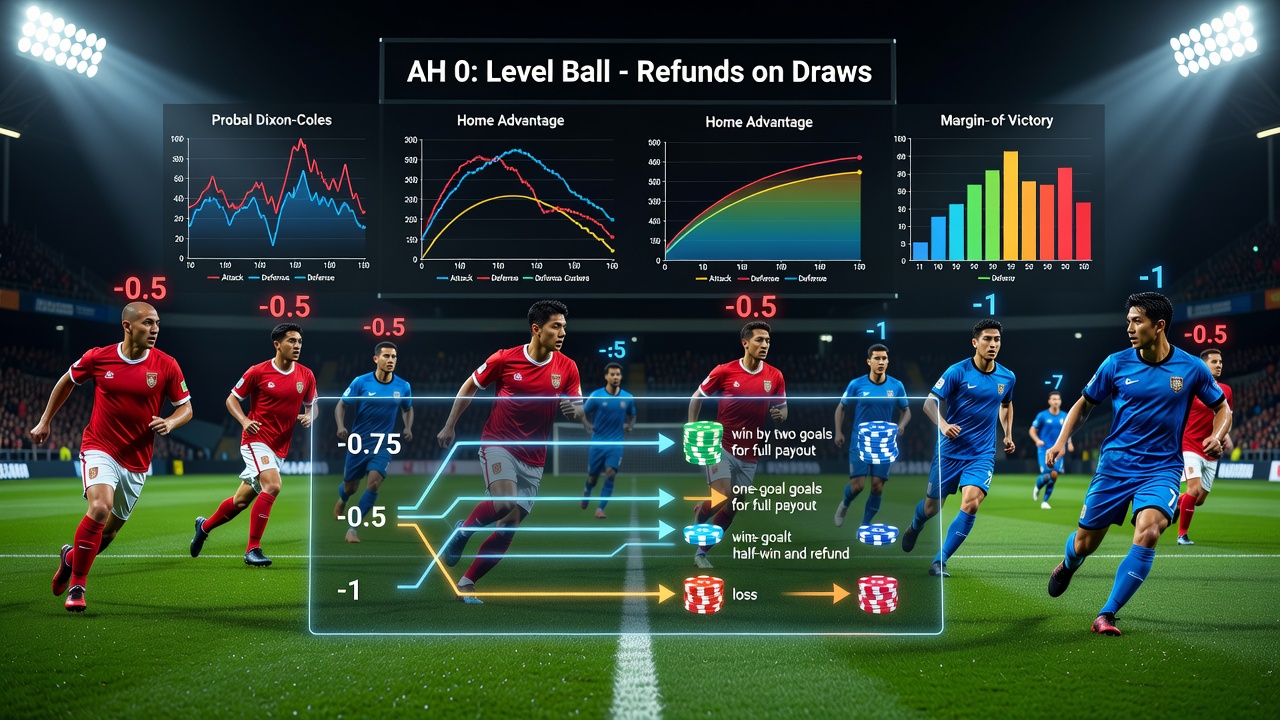
A quarter line such as -0.75 isn't a single bet - it's two bets fused together, half the stake on -0.5 and half on -1. The outcome depends entirely on the margin of victory:
- Win by two or more goals - both halves win, full payout.
- Win by exactly one goal - the -0.5 half wins, the -1 half is voided and refunded, producing a half-win.
- Draw or loss - both halves lose, full stake gone.
This splitting mechanism is what separates Asian Handicap from conventional spread betting. It creates partial-win and partial-refund scenarios that don't exist in Over/Under or 1X2 markets, and it means the expected value of a bet can shift meaningfully depending on which exact line - -0.5, -0.75, or -1 - a bookmaker offers for the same fixture.
AH 0 and Its Relationship to Draw No Bet
The simplest version, AH 0 or "Level Ball," applies no handicap at all. Win and you win the bet; draw and your stake is refunded; lose and you lose the stake. Functionally, this is identical to Draw No Bet. What differs is pricing. Asian Handicap markets generally carry deeper liquidity and tighter bookmaker margins than the equivalent DNB listing, which can translate into better odds for what is mathematically the same bet and settlement outcome. Bettors comparing the two markets side by side sometimes find a meaningful price gap for identical risk - a reminder that market structure, not just the underlying event, affects value.
Modelling Margins, Not Just Outcomes
Pricing Asian Handicap accurately requires more than predicting who wins - it requires estimating the full distribution of winning margins. Models built on frameworks like Dixon-Coles incorporate attack and defence strength, home advantage, and recent form to estimate the probability of a one-goal win versus a three-goal win, not just a win versus a loss. This is why a heavy favourite might be better value at -2.5 than at -1 in certain fixtures: if the underlying model assigns a high probability to a wide margin of victory, the deeper line can carry stronger expected value even though it looks riskier on paper.
Reading the Market Responsibly
Asian Handicap rewards bettors who understand probability distributions and market pricing, but no modelling approach changes the fundamental nature of sports betting as an activity carrying genuine financial risk. Quarter-lines and half-refunds can soften losses in specific scenarios, but they do not eliminate variance, and no system - statistical or otherwise - guarantees returns over time. Anyone engaging with these markets should treat published win-rate figures as historical context rather than a forecast, apply firm bankroll limits, and recognise that gambling is a form of entertainment with real financial consequences, not a reliable income strategy. Support is available through BeGambleAware.org for anyone concerned about their gambling, and betting products remain restricted to adults aged 18 and over.