
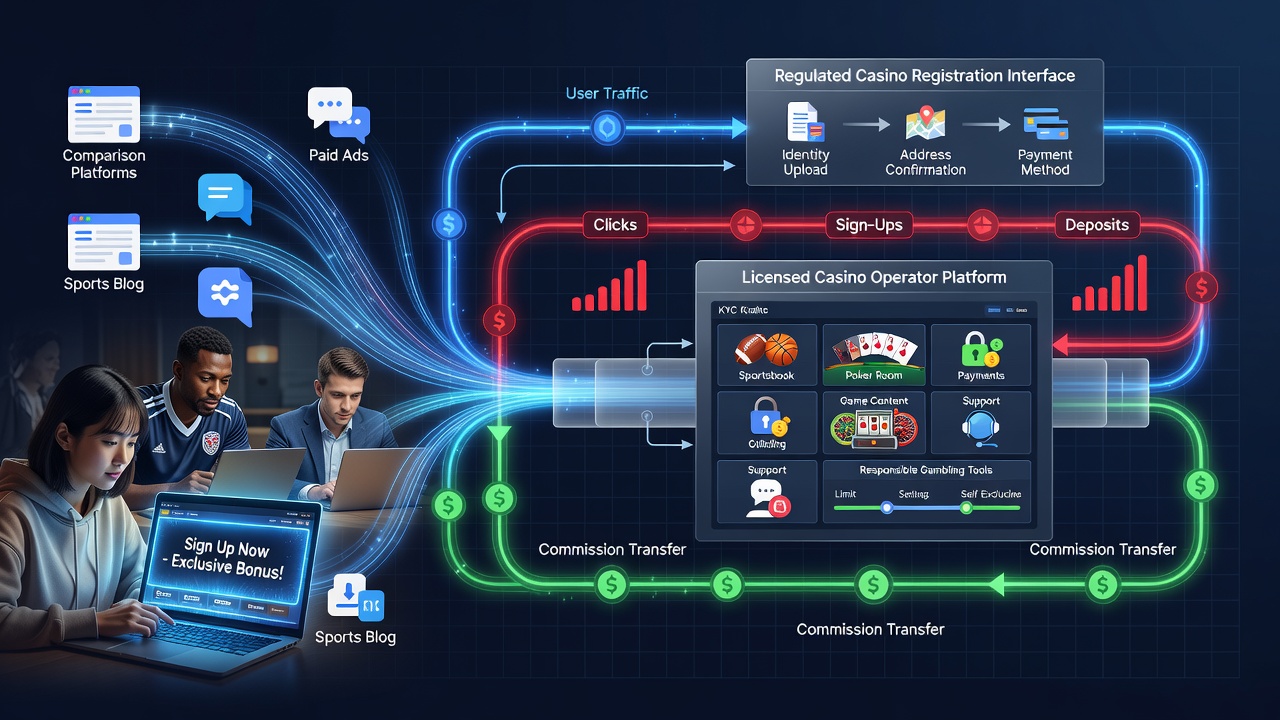
A player clicks a banner on a sports blog, lands on an online casino, deposits money - and somewhere in that chain, a commission gets paid. That simple surface hides a layered infrastructure of publishers, media buyers, tracking systems and compliance checks that now functions as one of the primary acquisition channels for regulated gambling operators worldwide.
Three Flows Hidden Inside One Transaction
What looks like a single referral is actually three parallel flows moving through the same pipeline: users, data and money. A user travels from a traffic source - a content site, a comparison platform, a paid ad - through tracking links to the operator's registration and KYC process. Data travels alongside, recording clicks, sign-ups, deposits and ongoing activity so the system can later attribute a result to the correct partner. Money follows last, moving from operator to affiliate once that result is verified. Each stage can fail independently: a tracking link can misfire, a KYC check can reject a user, an attribution window can expire before a deposit lands. The commission is never guaranteed by the click alone.
Who Actually Does What
The operator - a casino, sportsbook or poker platform - owns the regulated product itself: registration, payments, game content, customer support and responsible-gambling tools. The affiliate does not typically provide any gambling service; it provides audience and traffic. That distinction matters for regulators and for consumers, since liability for the product and for player protection sits with the licensed operator, not with the publisher who linked to it.
Between them sits the affiliate program, the commercial and technical rulebook governing the relationship. It defines which territories are permitted, which commission model applies - cost-per-acquisition, revenue share or a hybrid of both - how a "qualifying player" is defined, which traffic sources are allowed, and how disputes over attribution get resolved. A single operator brand may run several such programs across different markets, which is why experienced affiliates evaluate the program's terms as closely as the brand itself.
Affiliates themselves are not a uniform group. The term covers SEO-driven content sites, large sports-media brands, comparison platforms, mobile apps, individual media buyers and affiliate networks that aggregate many smaller partners. A media buyer spends directly on advertising inventory and optimises conversion funnels; a publisher builds owned media assets - content, apps, newsletters, communities - that generate traffic without a direct cost per click. Some of the larger public affiliate groups explicitly separate these as distinct business lines internally, since paid media carries direct advertising costs and different margin characteristics than publishing built on owned audiences.
Why Operators Choose This Model
Performance-based marketing lets an operator pay for outcomes - a deposited player, a verified sign-up, a share of ongoing revenue - rather than paying for impressions regardless of result. The logic is straightforward: if the commission paid to an affiliate is lower than the cost of acquiring that same player through in-house marketing, the channel is commercially worthwhile. This is why operators maintain internal marketing teams alongside affiliate programs rather than choosing one over the other; affiliates extend reach into audiences and niches the operator would otherwise have to build from scratch.
Where the Risk Actually Sits
Because affiliates influence how a gambling product is presented before a user ever reaches the operator, advertising standards, responsible-gambling messaging and jurisdictional licensing all become relevant upstream of the casino itself. Rules on what can be advertised, to whom, and in which market differ significantly by jurisdiction, and an affiliate operating across multiple GEOs must treat compliance as a standing obligation rather than a one-time check. Fraud controls, attribution accuracy and payout terms also sit at the center of ongoing disputes within the industry, since misattributed conversions or delayed reporting directly affect how commissions are calculated and paid. None of this changes the underlying nature of the product being promoted: gambling carries inherent financial risk for the player, and no marketing mechanism - affiliate-driven or otherwise - alters the house edge or the odds behind it.