
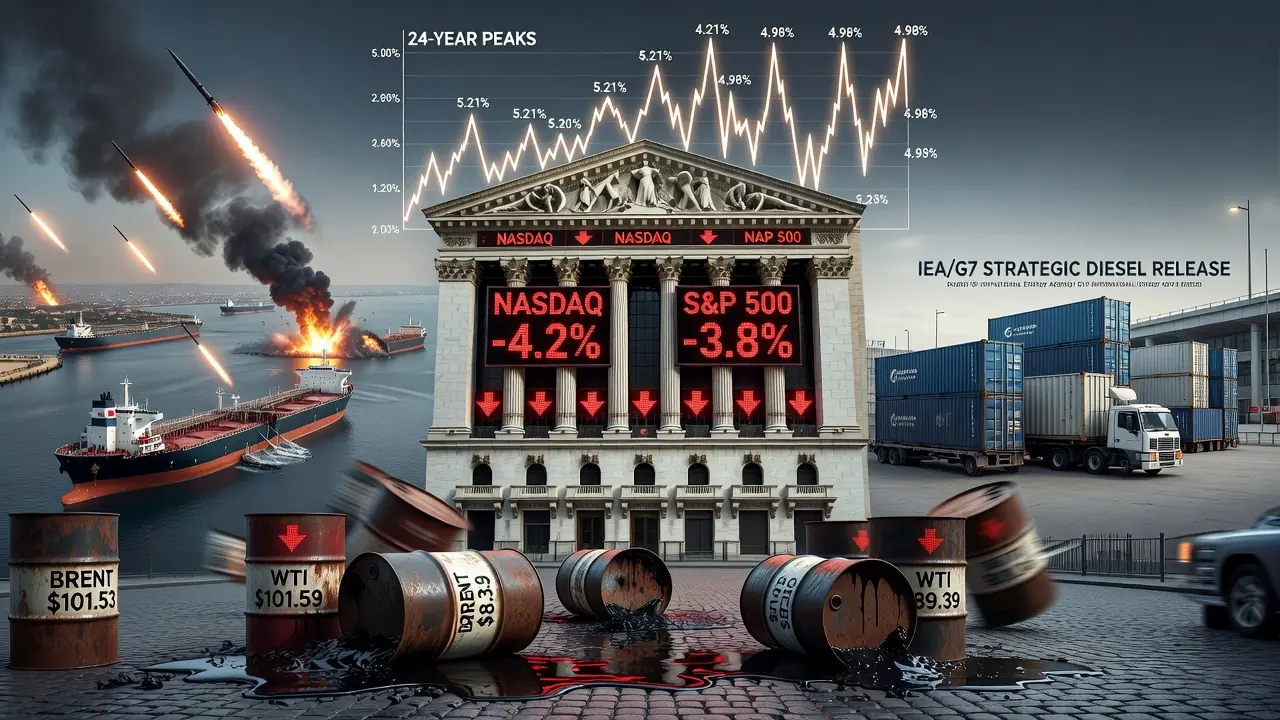
Wall Street's record-setting run hit turbulence this week as Treasury yields climbed to levels not seen in more than two decades, and oil prices swung sharply on renewed fears about Middle East supply disruption. Stocks closed lower on Wednesday, a day after both the Nasdaq and S&P 500 touched fresh record highs, as investors weighed the risk that elevated energy costs could keep inflation - and interest rates - higher for longer.
Why bond yields matter to every market
Treasury yields are the backbone of global finance. When they rise to multi-decade highs, as they have now, borrowing costs increase across the economy - from mortgages to corporate debt - and the relative appeal of safer, interest-bearing assets grows compared with equities. That dynamic explains why stocks can fall even after hitting records: investors recalibrate what they are willing to pay for future corporate earnings when the "risk-free" return on government bonds becomes more attractive. The current move reflects concern that persistently high oil prices will feed into broader inflation, forcing central banks to keep monetary policy tighter for longer than markets had hoped.
Oil markets caught between supply fears and reassurance
Crude prices have been volatile, with Brent crude futures rising to $101.53 a barrel and US West Texas Intermediate climbing to $89.39 a barrel, driven largely by an increase in attacks on shipping in the Gulf and the Strait of Hormuz - one of the world's most critical energy corridors. According to the UK Maritime Trade Operations agency, there were nine attacks on tankers in the strait this month alone, representing half of September's combined total for that waterway and the wider Gulf. Markets calmed somewhat after the International Energy Agency said member countries stand ready to release additional reserves if needed, prioritising diesel given tight supplies. That followed a coordinated G7 and IEA decision to release 100 million barrels of diesel and crude to ease concerns stemming from the fallout of the US-Iran conflict.
Conflicting signals on actual supply disruption
There is a notable gap between the rhetoric around the Strait of Hormuz and what tanker-tracking data actually shows. Maritime intelligence firm Kpler reported that Gulf oil flows, excluding Iran, recovered to more than 81 percent of pre-war levels in September, and that crude exports from the broader Middle East actually exceeded pre-war levels on 14 days during the month. US Secretary of State Marco Rubio reinforced this picture, stating that Washington considers the strait under control and that oil flows remain close to normal. Yet the human and operational cost of the heightened attacks is real: on Tuesday, 12 crew members aboard a Panama-flagged tanker were injured by an unknown projectile while transiting the strait, India's Ministry of External Affairs confirmed. Shipping companies are absorbing higher freight, insurance and security costs even as overall volumes hold up.
What this means for investors and markets ahead
The current environment illustrates how interconnected energy geopolitics, bond markets and equity valuations have become. Record highs in major indices do not eliminate underlying fragility - they can coexist with it. For investors, the key tension is whether oil-driven inflation pressure forces a policy response that undercuts the conditions that pushed stocks to records in the first place. For now, markets are pricing in uncertainty rather than crisis: supply has largely held despite the attacks, reserve mechanisms are in place, and officials on both sides are offering reassurance. Whether that balance holds depends heavily on how the situation around the Strait of Hormuz evolves in the weeks ahead.