
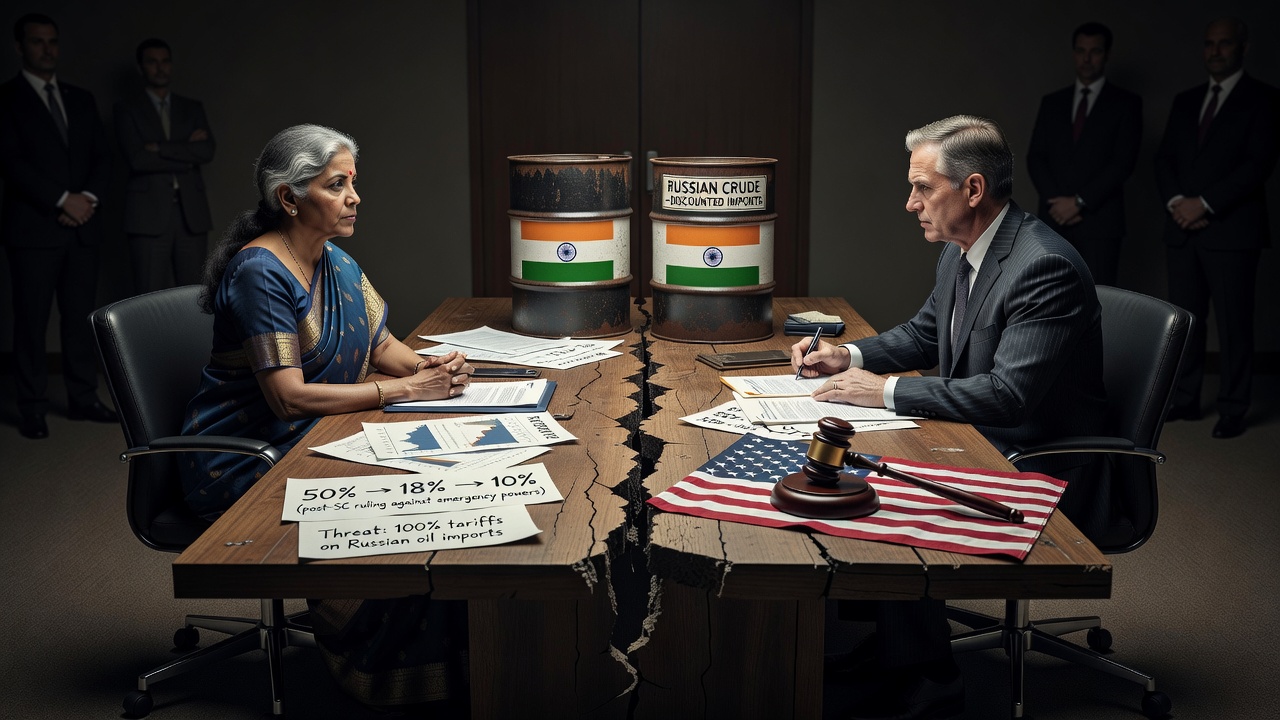
Negotiations between India and the United States to finalise a long-delayed bilateral trade agreement have hit another wall. Finance Minister Nirmala Sitharaman described the talks as reaching a "plateau," echoing a blunter assessment from US Trade Representative Jamieson Greer, who said a deal is not "imminent." The stalemate leaves two of the world's largest economies without resolution on tariffs that have already reshaped trade flows this year.
A Deal That Keeps Slipping
The two countries agreed on a framework in February that pulled the punitive tariff on most Indian goods down to 18% from a steep 50% imposed the previous August. Since then, the US Supreme Court struck down President Trump's use of emergency powers to impose sweeping global tariffs, resulting in a baseline 10% rate. Despite that legal shift and months of diplomatic engagement, no comprehensive agreement has emerged. Neither government has offered a detailed public account of why talks keep breaking down, but several structural obstacles are evident.
Russian Oil and a Looming Tariff Threat
A new US law allows tariffs on Indian goods of up to 100%, tied directly to New Delhi's continued purchases of Russian crude oil. Washington argues these purchases help fund Russia's war in Ukraine; India maintains that energy sourcing decisions reflect the practical needs of a population exceeding 1.4 billion people. Russian oil became commercially attractive after 2022 because of steep discounts, and instability in the Middle East has only reinforced India's calculus. Unless India adjusts its import pattern or secures a waiver under the sanctions law, this issue alone could push tariffs well beyond what either side envisioned during the February framework talks.
Unfinished Investigations and Sensitive Sectors
Complicating matters further, Washington has yet to conclude a Section 301 investigation examining whether excess industrial capacity in several countries, India among them, is undercutting American manufacturers. Until that probe concludes, India cannot know what tariff rate it will ultimately face, making it difficult to commit to concessions. On its side, India is trying to shield politically sensitive sectors such as dairy, poultry, rice and wheat from market-opening commitments, seeking tariff clarity from Washington before agreeing to open these markets. Key Indian exports, including generic pharmaceuticals and smartphones, currently sit outside the 10% baseline levy, a fact India has cited to argue its exports remain comparatively resilient.
Diplomatic Friction and What Comes Next
Trade talks are unfolding against a backdrop of strained diplomatic ties. A US military strike on a vessel off Oman that killed three Indian seafarers, along with India's rejection of Trump's repeated claims about brokering an India-Pakistan ceasefire, have added tension to the relationship. Even so, trade between the two countries has held up: Indian goods exports to the US rose to $42.79 billion in the April-August period, up from $40.39 billion a year earlier, with India posting a trade surplus of nearly $34 billion in fiscal year 2025/26. Analysts caution that without a finalised agreement, India remains exposed to tariff hikes stemming from both the industrial capacity probe and the Russian oil dispute, developments that could pressure the rupee, already trading near record lows, and dent broader market sentiment.
US Secretary of State Marco Rubio is expected in India later this month, offering a possible venue for renewed progress. Prime Minister Modi and President Trump, who spoke by phone on September 30, are likely to speak again soon, with a further meeting anticipated around the G20 leaders' summit in December. Whether these engagements can break the current impasse remains uncertain.